How can the endlessly intricate relationships that transform, move, and recycle the chemical elements essential to life, be captured in an image? Where should such an image begin and end? These were questions encountered by a group of researchers while developing and visualising the paper, Humans: Intertwined with life and the basic elements in the Anthropocene biosphere. The article, published in September 2026 in Ambio, brings together evidence from across physiology, microbiology, ecology, Earth system science and art, to examine what it means for a human to be intertwined and embedded in the biosphere.
We approached the question by first focusing on the human body itself. Our bodies are open living systems, continuously taking in, transforming, and releasing the chemical elements that allow us to function. The oxygen we breathe, the water we drink, and the nutrients contained in our food don’t arrive from an inert, fertilised physical environment. Microorganisms, fungi, plants, and animals continually mobilise, transform, transport, concentrate and recycle chemical elements, from microbes making minerals available to plant roots, to marine organisms incorporating trace elements into food webs. Human metabolism is embedded within much larger life-mediated cycles.
But turning this kind of perspective into a conventional scientific figure proved to be beyond the capacity of scientists. A diagram introduced boundaries that the subject itself resisted. At what scale should we work: cells, bodies, ecosystems, the whole Earth system? Which relationships should be represented, and which left out? Can academic figures feasibly stretch across three pages? Arrows suggested directions for things that were multidirectional and context dependent. Attempting to include everything was impossible, and choosing to highlight a handful of processes risked the complexity that was central to the text.
As researchers, our author group was comfortable synthesising and interpreting evidence in words, but much less so visually. Scientific figures often, and necessarily, carry an expectation that each component has an intended and accessible meaning. We worried about interpreting too freely, privileging some relationships over others, or creating a visual hierarchy that was at odds with the science. Perhaps most importantly, the paper ultimately argues for more than recognising a set of biogeochemical dependencies. It points towards what these dependencies mean for biosphere stewardship: for cultivating care, attention, and appreciation for a web of relations of which humans are part. A schematic diagram increasingly seemed unable to express what we were trying to say.
Finding a collaborator
The dilemma brought us to Norwegian artist Tone Bjordam. Transformation in nature and the forms and patterns produced by geological, climatic and biological processes have been central to Tone’s artistic practice for decades. Working across drawing, painting, photography, video, performance, sound and sculpture, she moves between microscopic and landscape scales. Her studio lies in Nordmarka, in the forest outside Oslo, where she cites the changing forest, water, ice, clouds, rocks, mosses and lichens as both materials and subjects for her work.
Tone had existing experience working with academics, including Carl Folke, Karen O´Brien and Marten Scheffer, members of the Laboratory’s Scientific Committee. Tone has presented and exhibited at scientific conferences, contributed to scientific publications, and continued to explore the space between science and art. Her work has previously featured in activities organised by the Anthropocene Laboratory.
From conversation to collaboration
In mid-March 2026, we met Tone over video. Tone had already engaged with the manuscript. We talked about pollen, microorganisms and elemental cycles, microscopic and planetary scales. Rather than trying to design a diagram in which relationships, elements, and nutrients could be followed from A to B, we discussed an image that could express complexity, reciprocity and movement. An image in which a person, and agricultural systems with human hallmarks, were visible yet visibly within a broader biosphere.
A few weeks later, Tone presented potential source material from both online and in her studio, alongside an early collage of motifs which was still in flux. The difficulty of fitting life-element relationships neatly into one visual system seemed to have provided a creative starting point. And as Tone continued to develop the work, the exchange flowed back into the manuscript itself.
One example concerned the mineral and abiotic foundations of the processes we were describing. Our focus on life-mediated elemental cycles had the potential to overemphasise certain organisms, particularly those considered charismatic. Tone’s attention to rocks, minerals and crystalline forms helped sharpen the need to keep visible the geochemical partners with which life continually interacts. Both the text and the illustration’s eventual composition therefore reach beneath soils, roots and microorganisms into underpinning mineral forms.
The Elements of Life
The resulting work, The Elements of Life, is an ink drawing and aquarelle on watercolour paper. Its composition is looping, but it is not intended as a diagram of a single cycle. A human figure exists in the composition without occupying its centre and contributes to a broader sense of movement in partnership with the other components. Around and through her appear human cells and microorganisms, pollen and phytoplankton, fungal mycelia and plant roots, soil organisms and minerals, salmon, seabirds, reindeer, and a humpback whale.
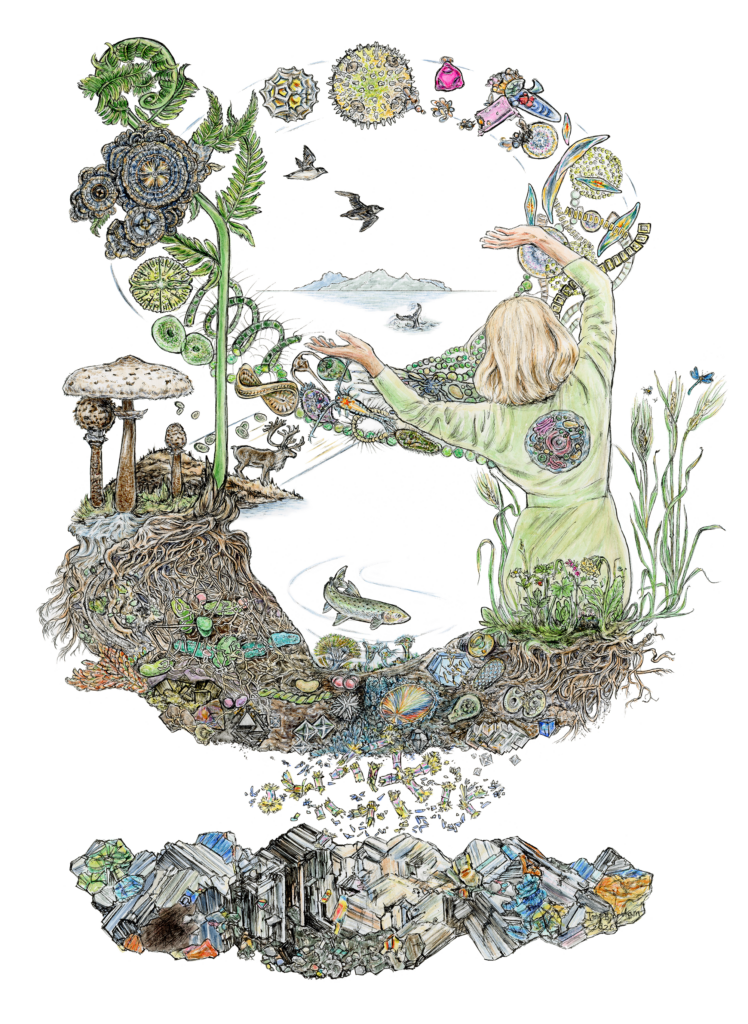
There are 58 individually identified motifs in the annotated version of the artwork, from an Asgard archaeon and manganese-oxidising bacteria to a nematode, pumpkin pollen, the little auk, and chalcopyrite. Some correspond to examples developed in the paper, while others establish connections between scales and ecosystems that weren’t offered sequentially in the text. The illustration rewards both slow viewing and a propensity to zoom in on its different components. While a general cyclic movement is apparent, closer inspection reveals organisms within organisms, tangled and mutualistic partnerships, and relationships that cross boundaries between body, soil, water and atmosphere.
More than an illustration
In retrospect, a schematic representation would have undermined what the article aimed to communicate. Human beings do not stand in the middle or at the end of a given elemental cycle, receiving nutrients and their benefits from an external natural world. We exist inside a coevolved history of biological and geochemical relations that constitute us and pass continuously through our bodies.
Or, in Tone’s words:
“The world does not belong to us; however, we belong to the natural world.”
Accepting that we could not adequately visualise this alone opened the paper to a mutualistic and fruitful collaboration.
As with The Elements of Life itself, there is no single, correct place to begin looking at the intertwined relationships that makes human life possible. This collaborating combines knowledge to a larger picture, and it is our hope that it can stimulate both a sense of wonder – and further collaboration. Tone express her way of looking at the world in ways that inspires us: “I find the microcosmos that surrounds us on a daily basis, just as mysterious and fascinating as gazing into universe.”