Human life, like all life, coevolves with the living conditions on Earth. A new publication presents new emerging opportunities to grapple with this embeddedness in the biosphere.
Kaandorp, C., Wang-Erlandsson, L., Hattle, A., Folke, C., Gelves-Gomez, F., Rocha, J., Hartman Davies, O., Daily, G., Donges, J.F., Flores-Santana, C., Galbraith, E., Goldin, S., Jobbágy, E., Søgaard Jørgensen, P., König, A., Lambin, E.F., van der Leeuw, S., Milo, R., Ningrum, D., Nyström, M., Reyers, B., Schill, C., Senneby, J., Taniguchi, M., Österblom, H. (2026) Opportunities to foreground human embeddedness in the Anthropocene biosphere. Cell Reports Sustainability. https://doi.org/10.1016/j.crsus.2026.100734
Abstract
Human life, like all life, coevolves with the living conditions on Earth. A new publication presents new emerging opportunities to grapple with this embeddedness in the biosphere.
- Treating humans and nature as separate is widely recognized as a barrier to addressing sustainability challenges.
- This paper introduces three dimensions for understanding how humans are embedded in nature: compositional, relational, and evolutionary.
- Opportunities exist to move sustainability science beyond human-nature dualism and focus more on embeddedness, through new approaches to sensing, modeling, and commoning practices
The climate crisis, geopolitical conflicts, increasing inequality, and rapid biodiversity loss require a rethink of our relationship with nature. Instead of viewing humans as apart from nature, it is time to realize that humans, our cultures, and social structures are part of and dependent on the biosphere.
“Human societies do not exist in parallel beside the biosphere but rather are embedded within the continuum of its living fabric,” write a group of twenty-five scholars and artists in a new paper in Cell Reports Sustainability.
The group includes eight Centre researchers and colleagues from the Anthropocene Laboratory at the Royal Swedish Academy of Sciences, as well as researchers from e.g., the Potsdam Institute for Climate Impact Research, the Bolin Centre for Climate Research, Stanford University and University of Pretoria.
The paper emerged from a series of workshops organized by the Anthropocene Laboratory. The workshop were part of the one of the research topics of the Laboratory: the Intertwined Biosphere. With this topic, we aim to foster an intertwined understanding of the Anthropocene biosphere in science, policy, and practice.
Three dimensions of embeddedness
The paper argues that that it is time to “prioritize care for living systems and foster beneficial outcomes for all organisms”. The authors conclude that sustainability challenges require a concerted push to embrace frameworks, methods, and insights for profoundly recognizing humanity’s situatedness in the biosphere. The paper is a so-called perspective piece and it introduces three dimensions for understanding this embeddedness of humans in nature: compositional, relational, and evolutionary embeddedness:
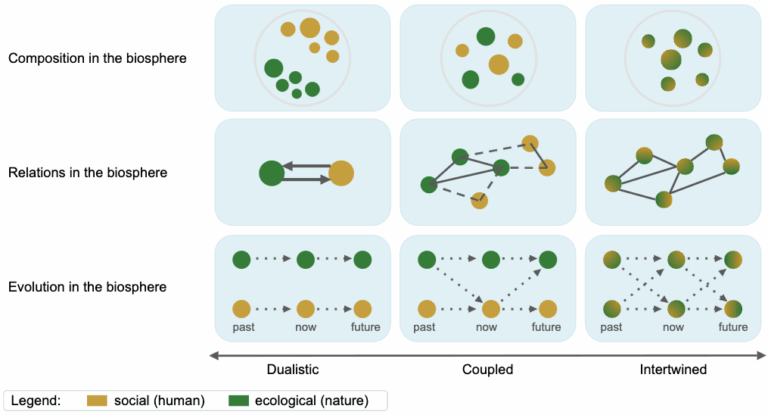
- Compositional embeddedness highlights the intertwined composition of elements in the biosphere. It is exemplified by the human body and its symbiosis with gut microbiota, shaped by what we eat and the environments we inhabit.
- Relational embeddedness emphasises how life emerges through various relationships. Cultivating vegetables or implementing a biodiversity policy, for example, transforms soil and its microbiome, which in turn affects human bodies in different ways.
- Evolutionary embeddedness refers to how changes in nature happen through a series of events and processes that unfold over time. It is illustrated by agricultural intensification through heavy chemical inputs and machinery, which gradually reduces microbial diversity and degrades soil fertility. This can result in less nutrient-dense crops, impoverished diets, and impacts on both human well-being and decision-making in the long run.
The paper also applies the three dimensions to freshwater. Water is present in the composition of all living matter, including our own bodies, other animals, vegetation, soil, and the atmosphere; relationally shaped by how land use and human activity influence rainfall and water cycles; and evolutionarily tied to processes like groundwater reserves built up over thousands of years and now being depleted faster than they can recharge.
Foregrounding embeddedness in the biosphere
Finally, the authors highlight opportunities that facilitate the study of embeddedness in sustainability science. These include ‘sensing practices’that open science to diverse knowledge systems and technologies, modeling approaches that better represent the interplay between social and natural dynamics, and ‘commoning practices’ that foster shared responsibility and collaborative governance across human and non-human actors, such as citizen assemblies or incorporating nature in jurisprudence. Each of these also raises ethical questions, from how data is used to whose knowledge counts and who gets included.
Attention to embeddedness can help science and policy better address sustainability — and new developments in sensing, modeling, and commoning practices are now making that possible in ways previously out of reach. As such, this paper presents promising opportunities to move away from human-nature dualism and support the intertwined living world.