The Swedish Royal Academy of Sciences has periodically published booklets titled Vetenskapen säger (“What Science Says”). To mark 25 years since the concept of the Anthropocene was introduced, the Academy issued a new booklet dedicated to the Anthropocene, which was distributed to young people in Sweden. It is written in simplified Swedish, and the Anthropocene Laboratory plans to create an English version with some additions. The text below is an English translation of an interview with our Director Henrik Österblom.
It was the Nobel Prize–winning chemist Paul Crutzen and the biologist Eugene Stoermer who popularised the concept of the Anthropocene at the beginning of the 2000s. They argued that our current age is characterised by humanity having a profound impact on nature, the climate, and the entire Earth system.
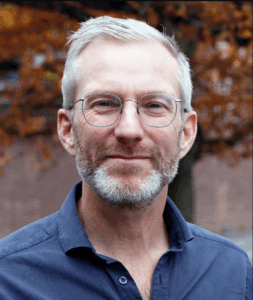
Henrik Österblom explains:
“Some argue that it began when we invented fire, or when we built the great cities. But in reality, that impact was fairly limited and local. What happened sometime after the Second World War was that we began to affect the entire world, resulting in, among other things, climate change and species extinction. Today, we leave a global fingerprint everywhere.”
The publication shows that developments since the 1950s—when humans began using fossil fuels on a large scale—meant human impact at a completely different level than at any earlier point in history. Since then, carbon dioxide emissions have increased at an ever-accelerating pace, which is the main cause of climate change.
A Useful Concept
At first, the term Anthropocene was used primarily within geology and environmental science. In recent years, it has spread to many other fields of research such as archaeology, history, philosophy, political science, and the humanities, and it is also used within the cultural sphere.
“It is a very useful concept that highlights how we humans shape the entire planet, which also gives us total responsibility. Now it is up to us!”
Starting to Reflect
This is also where Henrik Österblom finds hope for the future. He wants young people who read the publication both to understand how serious the situation really is and to feel that, despite everything, there is still an opportunity to do something. There are many positive examples of change, and we can all contribute to a better world.
“I hope young people will think that this really matters—that it concerns our entire future. But at the same time, I hope they begin to reflect on how they themselves can bring about change,” says Henrik Österblom.
He notes that interest in environmental issues among young people has declined from its peak around 2019. At the same time, many young people feel worry and anxiety about current developments.
Vacuuming the World
At the Anthropocene Laboratory, researchers have been “vacuuming” the world for examples of how sustainable change is emerging. One such example is how countries have begun changing their laws to grant nature its own legal rights. In Ecuador, this has led to stronger protection for mountains, rivers, and animals—and companies have been required to compensate for the damage they have caused to nature. While politicians rewrite national constitutions, young people are also contributing by driving legal cases against both companies and entire nations.
The publication What Science Says – About the Anthropocene was launched digitally on December 1, at the same time as the Anthropocene Laboratory hosted a scientific symposium at the Royal Swedish Academy of Sciences. The symposium, The Anthropocene Paradigm Shift, has attracted over 100 participants and was opened by Johan Rockström.